

October 12, 2026
Echo45 Advisors Investment Committee
Four years ago, the S&P 500 reached its lowest level of the 2022 bear market in October. At the time, inflation was climbing at its fastest pace since the 1970s, the Federal Reserve was raising interest rates rapidly, and recession fears were widespread. Sentiment among consumers, businesses, and investors was deeply negative, and it was difficult to imagine conditions improving.
Fast forward to today, and the situation couldn’t feel more different. Major indices are near all-time highs and the economy has been resilient, driving corporate earnings higher and keeping the unemployment rate low. Inflation is still a challenge with energy prices being a key source of uncertainty this year, but it is no longer rising at a double-digit pace.[1] The S&P 500 has more than doubled over this period, supporting investors who have maintained a long-term focus in their portfolios and financial plans.
As the bull market enters its fifth year, the shift in investor sentiment over this period is an important reminder that market and economic conditions can turn around when they’re least expected. And while this is all positive for long-term investors who stuck to their plans, the goal is neither to celebrate nor become complacent, but to stay balanced and focused on long-term financial goals.
Perspective matters as we begin the fifth year of the bull cycle
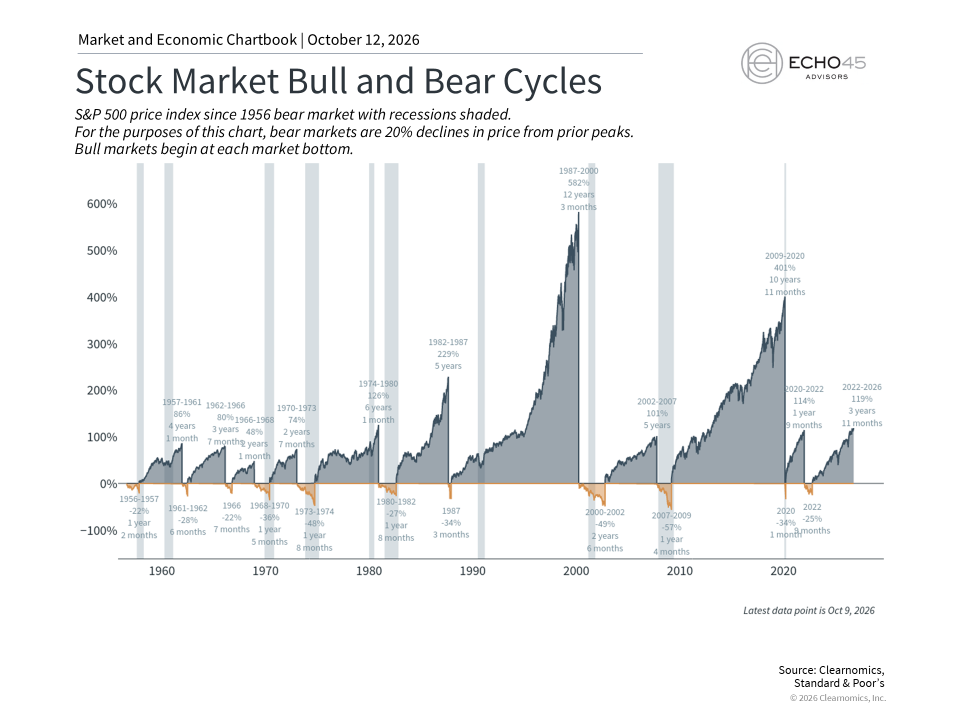
The S&P 500 reached its bottom on October 12, 2022, alongside other asset classes such as bonds, amid inflation concerns. Since then, the index has gained around 119% on a price return basis, and 131% with reinvested dividends.[2] Not only does this mean that stock market holdings have more than doubled over this period, but this is now one of the strongest bull market cycles since World War II, as shown in the chart above.
Historically, bull markets have lasted far longer than bear markets, often running five to ten years or more, including two recent cycles that lasted more than a decade. Of course, no two market cycles are identical, and past performance is no guarantee of future results. After all, markets never rise in a straight line.
The market cycle that began in 2020, for instance, was interrupted in 2022 due to inflation. At the same time, many challenges that seemed important at the time only became temporary speed bumps. For instance, the long bull markets of the 1990s and the 2010s each faced serious challenges along the way, including growth concerns, geopolitical events, fiscal challenges, oil price shocks, and periods of elevated valuations. And yet, consumers and businesses adapted to these conditions, allowing markets to recover.
Today’s cycle is no exception and has already faced periods of significant volatility, such as the sharp pullbacks in 2025 around tariffs and earlier this year due to the war in Iran. Zooming out, it’s easy to see that these episodes are a normal part of any market cycle. As the bull market continues, it’s an important time for investors to stick with a well-constructed portfolio that can handle all types of market environments.
New all-time highs are a normal part of the market cycle
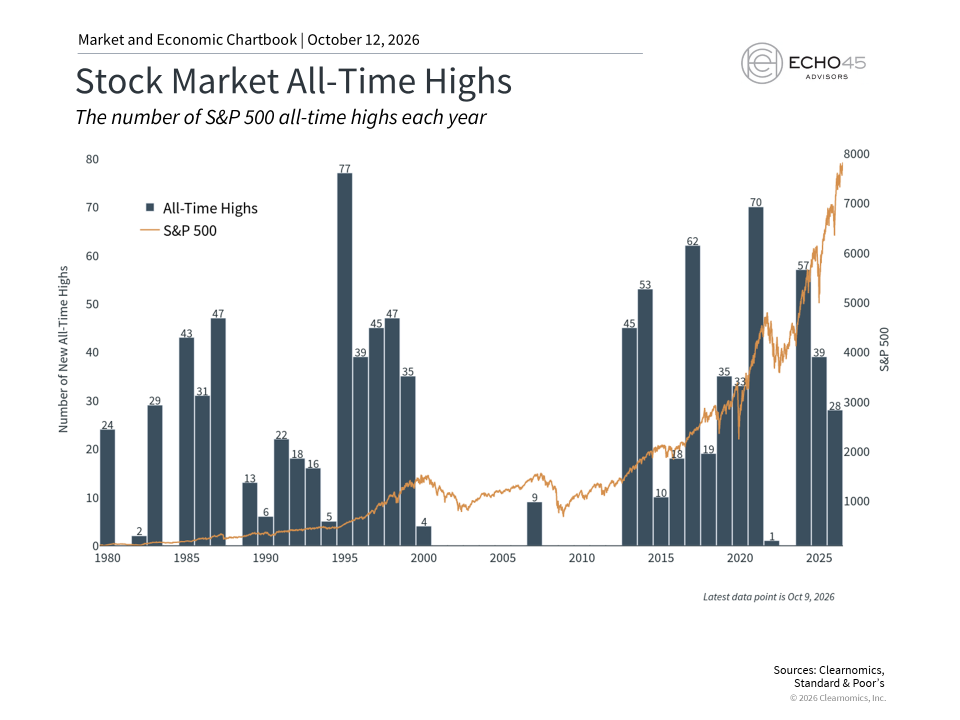
The market cycle hasn’t simply continued, but has reached record levels. This year alone, the S&P 500 has achieved more than two dozen new all-time highs.[3] This can lead to mixed feelings among investors, since some may worry that the market is “due for a pullback,” while others may feel that they’re missing out.
As always, it’s important to stay balanced and to have a longer historical perspective. The chart above shows how frequently the S&P 500 has set new all-time highs across different market cycles. History shows that it’s not unusual at all for markets to rise steadily during bull markets and, by definition, achieve new all-time highs. Over the past decade, for instance, the S&P 500 has reached dozens of new highs each year, except during the bear market in 2022 and as major indices recovered in 2023.
This does not mean risks are absent or that new highs should be taken for granted. Rather, it reflects the fact that the economy and corporate sector have been resilient in the face of significant headwinds. Recognizing this pattern and resisting the urge to step aside every time markets approach record territory is one of the most valuable habits a long-term investor can develop.
Valuations have improved, but risk management remains important
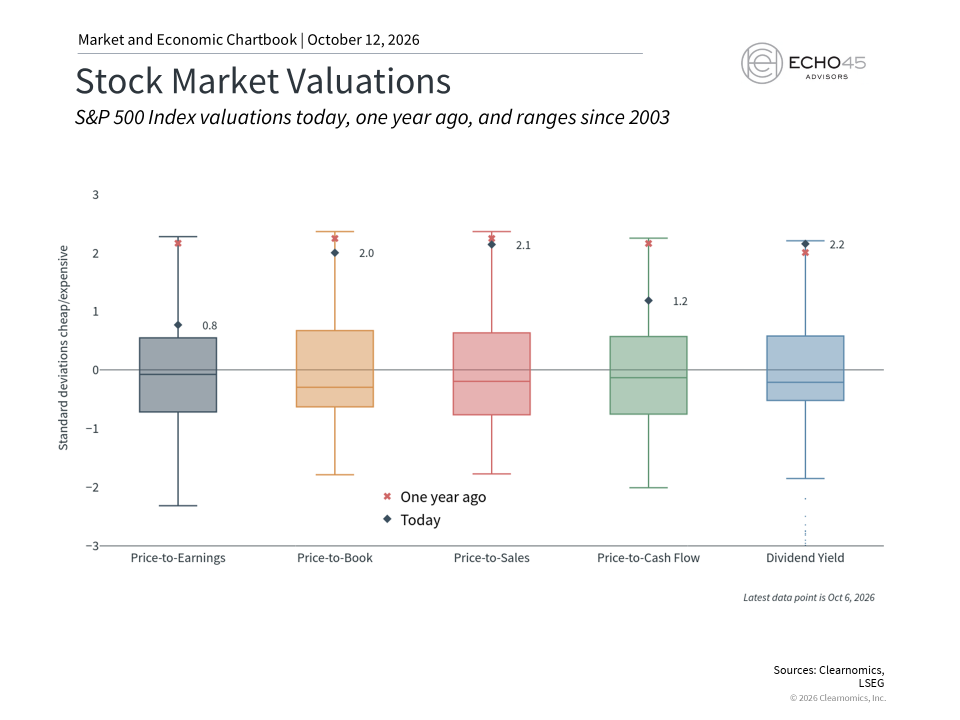
Markets hovering at high valuations mean it’s important to consider potential opportunities across asset classes, as well as risk management. Valuations matter to long-term investors because they don’t just reflect the price of the stock market, but what you get for that price. This matters because investors own shares of stock to benefit from the earnings, cash flow, dividends, and other fundamental measures that they are entitled to. Valuation metrics take a ratio of the share price against each of these measures to show what investors are getting for that price.
The accompanying chart shows various valuation measures for the S&P 500. Strong earnings growth over the past year, including consensus estimates pointing to over 30% earnings growth for 2026, has helped bring the price-to-earnings ratio down from its peak just a year ago.[4] This is a positive and suggests that much of the market's gains have been supported by corporate profitability rather than by investor enthusiasm alone.
At the same time, valuations remain above their long-run historical averages based on other measures. Price-to-book, for instance, is a classic metric used by value investors, and suggests that the market is still expensive when considering company assets and balance sheets. The same is true for measures such as dividend yields, which are historically low when compared to interest rates and bond yields today. In addition, an important part of the story is that valuations appear high in technology-related sectors but can differ across many parts of the market.
It’s important to remember that valuations are not short-term timing tools, but help to position portfolios over years and decades. Markets can stay elevated for extended periods, especially when earnings growth is strong. That said, higher valuations can suggest that unless fundamentals change, the margin for error is smaller. This raises the importance of holding different asset classes to balance a portfolio, ensuring it stays aligned with long-term financial plans. Bond yields, for instance, are near multi-decade highs, making them more attractively valued.[5]
The bottom line? As the bull market begins its fifth year, it’s a good time to reflect on the positive developments over this market and economic cycle. Uncertainty is a natural part of investing, so staying balanced and focused on long-term financial goals remains important.
References
1. https://www.bls.gov/news.release/cpi.nr0.htm
2. Clearnomics research using Standard & Poor’s data, from October 12, 2022 to October 9, 2026
3. Clearnomics research and S&P 500 data, as of October 9, 2026
4. Clearnomics research and LSEG data, as of October 9, 2026
5. https://home.treasury.gov/policy-issues/financing-the-government/interest-rate-statistics
Index Descriptions
S&P 500
The Standard & Poor’s 500 Index is a capitalization-weighted index of 500 stocks designed to measure performance of the broad domestic economy through changes in the aggregate market value of 500 stocks representing all major industries. The modern design of the S&P 500 stock index was first launched in 1957. Performance prior to 1957 incorporates the performance of the predecessor index, the S&P 90.
Echo45 Advisors LLC is a Registered Investment Advisor. Registration does not imply any level of skill or training. The information and statistics in this report has been obtained from Clearnomics, a separate and unaffiliated organization. Based on our own due diligence, we believe Clearnomics to be reliable but we do not warrant their accuracy or completeness. This report is for your information only and does not constitute an offer to buy or sell, or the solicitation of any offer to buy or sell any securities. Advisory services are only offered to clients or prospective clients where Echo45 Advisors LLC and its representatives are properly licensed or exempt from licensure. Past performance is no guarantee of future returns. Investing involves risk and possible loss of principal capital. No advice may be rendered by Echo45 Advisors LLC unless a client service agreement is in place.
© 2026 Clearnomics, Inc. All rights reserved. The information contained herein has been obtained from sources believed to be reliable, but is not necessarily complete and its accuracy cannot be guaranteed. No representation or warranty, express or implied, is made as to the fairness, accuracy, completeness, or correctness of the information and opinions contained herein. The views and the other information provided are subject to change without notice. All reports posted on or via www.clearnomics.com or any affiliated websites, applications, or services are issued without regard to the specific investment objectives, financial situation, or particular needs of any specific recipient and are not to be construed as a solicitation or an offer to buy or sell any securities or related financial instruments. Past performance is not necessarily a guide to future results. Company fundamentals and earnings may be mentioned occasionally, but should not be construed as a recommendation to buy, sell, or hold the company’s stock. Predictions, forecasts, and estimates for any and all markets should not be construed as recommendations to buy, sell, or hold any security--including mutual funds, futures contracts, and exchange traded funds, or any similar instruments. The text, images, and other materials contained or displayed in this report are proprietary to Clearnomics, Inc. and constitute valuable intellectual property. All unauthorized reproduction or other use of material from Clearnomics, Inc. shall be deemed willful infringement(s) of this copyright and other proprietary and intellectual property rights, including but not limited to, rights of privacy. Clearnomics, Inc. expressly reserves all rights in connection with its intellectual property, including without limitation the right to block the transfer of its products and services and/or to track usage thereof, through electronic tracking technology, and all other lawful means, now known or hereafter devised. Clearnomics, Inc. reserves the right, without further notice, to pursue to the fullest extent allowed by the law any and all criminal and civil remedies for the violation of its rights.